AI search is changing how donors find charities. Here's what to do about it.
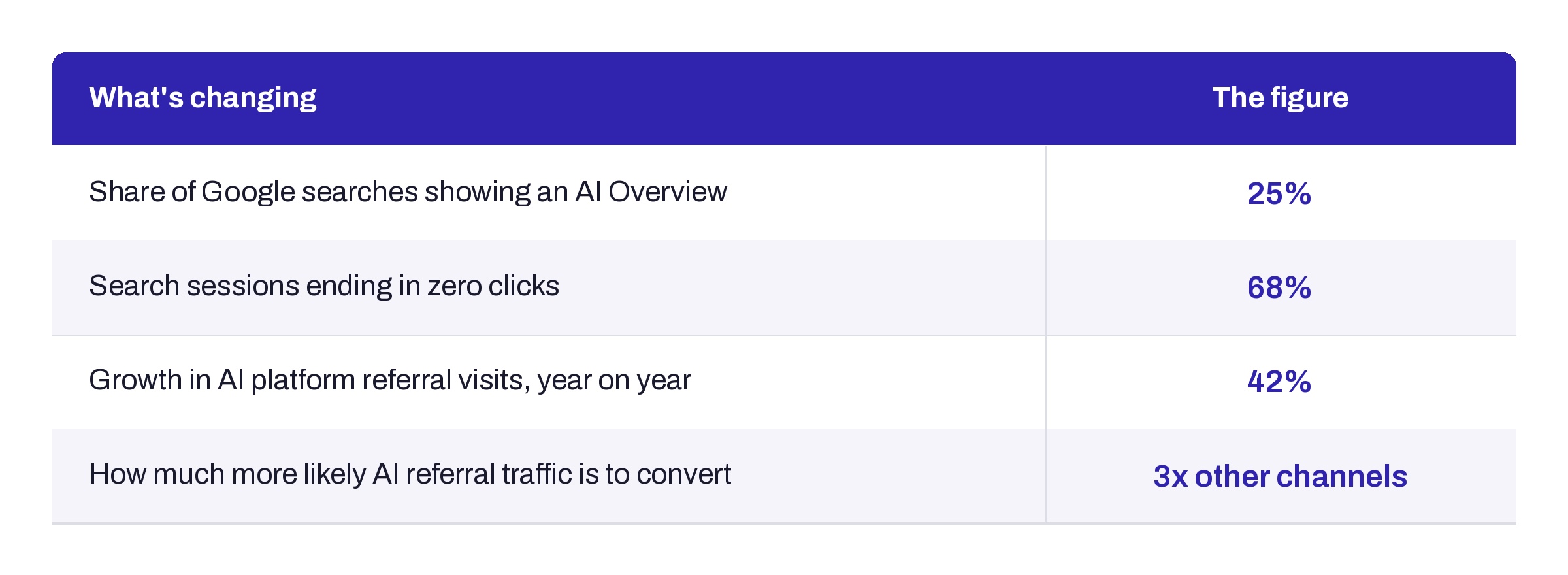
In short: More and more donors get their answers from AI, and that means fewer click through to a website. About a quarter of Google searches now show an AI Overview, and 68% of searches end without a single click through to a website. AI tools name the charities whose mission, impact and key facts are easy to access and verify. Charities that haven't set themselves up for this are slowly dropping out of view, often without knowing it.
A year ago, if a prospective donor wanted to know which children’s charity to donate to, or how a mid-size environmental group's carbon offset program worked… they typed a question into Google, scanned ten blue links, and picked one. That behaviour is going away, and there are no signs of it coming back.
Today, a growing share of those same questions never produce a click at all. They produce an answer, written by an AI overview, delivered in a box above everything else on the page. According to a 2026 analysis of billions of search visits, Google's AI Overviews now appear on roughly a quarter of all searches. When they do, users click through to a website in only 8% of instances. Most of the time, nobody clicks at all.
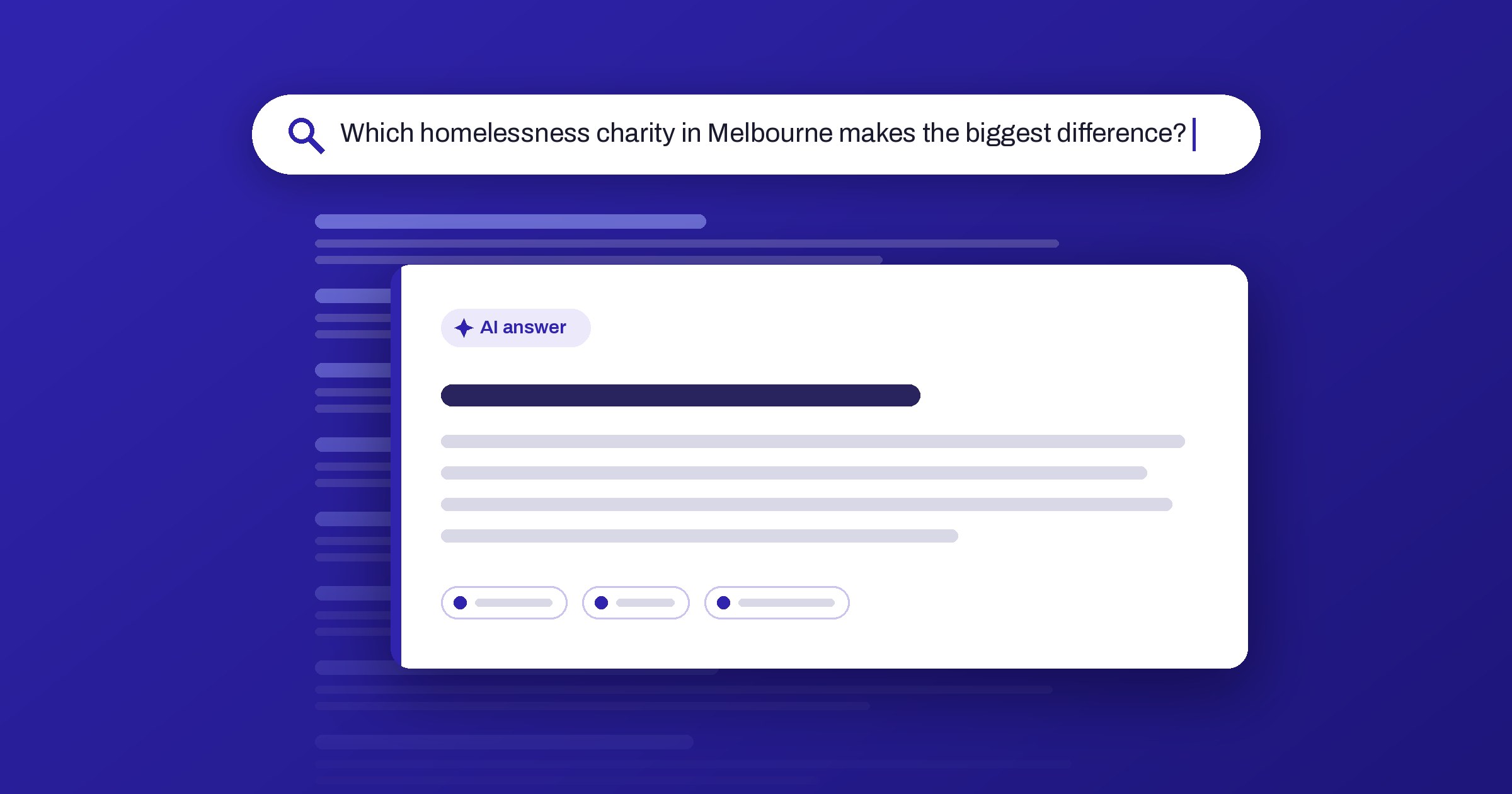
Meanwhile, more and more Australians are skipping Google and asking AI tools like ChatGPT, Claude, Gemini and Perplexity directly. They ask things like "which homelessness charity in Melbourne makes the biggest difference?" or "is this environmental group legitimate?” and "how do I compare children’s charities?" Visits from AI platforms grew almost 42% year on year in early 2026, according to Adobe. Those visitors are also about three times more likely to convert than visitors from other channels.
In other words, people are browsing less and trusting the answers they're given by AI.
What zero-click search means for charities
68% of search sessions end in zero clicks. Not a lower click rate. No click at all. For most of those searches, a charity's website is never even visited, let alone donated through.
A commercial retailer can work around that. For charities, the stakes are higher. Much of the sector's digital fundraising growth over the past decade came from search behaviour that's now disappearing: a donor searches for a cause, lands on a well-built page and gives. That path still exists, but it's getting smaller. Charities that still plan their whole digital strategy around it will feel the change first
 Source: Contently's 2026 analysis of AI Overview traffic.
Why some charities get named and others don't
Prospective donors rarely ask AI general questions. They ask specific ones, like "which children's hospital charity in Australia spends the least on admin?" and the AI assistant answers with a named organisation, a percentage, and a one-line explanation of how that figure was calculated.
Say three charities have equally low admin costs, but only one gets named, because only one had that figure published somewhere structured and verifiable enough for the AI system to find, trust and quote with confidence. The other two were just as worthy of the donation. They simply weren't legible to the system doing the recommending.
That's the key point. AI search rewards charities that make their facts easy to find, regardless of the quality of their work.
Traditional SEO still matters. GEO now matters too.
SEO (search engine optimisation) isn't going anywhere. Organic search, paid search and Google Ad Grants will remain the biggest source of new supporter traffic for most charities for years yet, but ranking well no longer guarantees you'll be found.
A charity can hold position one for "youth mental health support Sydney" and still lose the donor, because the donor asked an AI assistant the same question and got an answer that named a different organisation: one the AI system judged to be a clearer, more citable, more trustworthy source. 77% of Australians now use AI as part of their online researching, 12% exclusively use AI tools.
AI brings a different competition, with different rules: Being ranked matters. Being correctly understood now matters more.
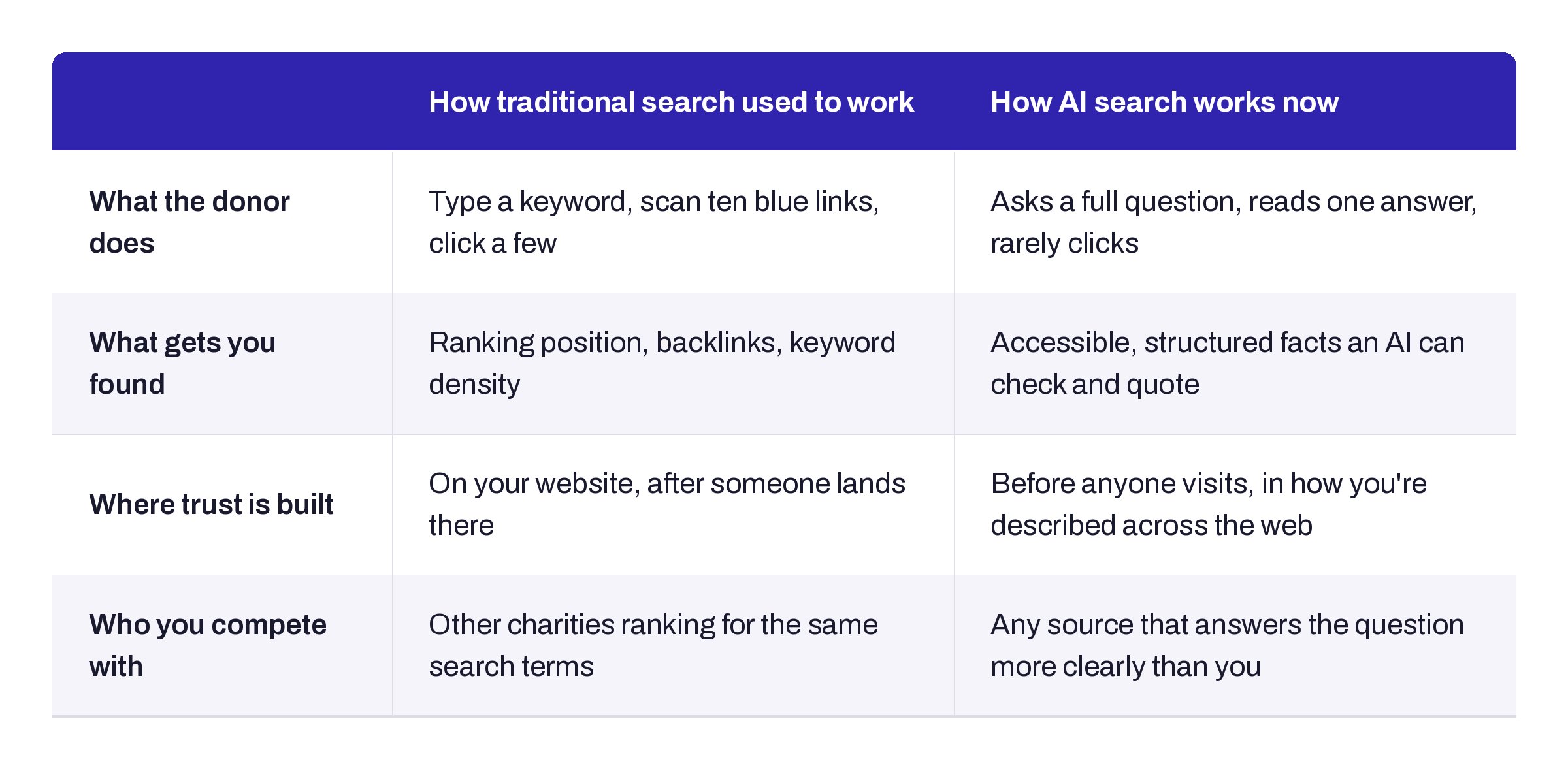
That's where generative engine optimisation, or GEO, comes in. GEO means making sure AI tools can understand your charity and describe it accurately. Traditional SEO helps Google rank your pages. GEO helps AI tools find your mission, programs and impact, check them, and sum them up correctly. Both work best together.
 If you're thinking "haven't we heard this before?", fair enough. Voice search and plenty of "Google is dying" headlines came and went without upending fundraising.
However this time, the change already shows up in the traffic data, so treat GEO as a normal part of your digital strategy, the way mobile-friendly design became standard a decade ago, and keep doing the SEO basics well.
The advantage charities have at winning AI search
Most commentary on AI search is written for retail and B2B marketers, so it misses something important. In many ways, this change favours charities.
At their core, AI tools look for sources they can trust and understand before they quote them. Charities already have two things most brands work hard to create: a clear reason to exist, and independent proof of impact. A well-run charity can say in one sentence who it helps, what it does and why it matters. It can back that up with annual reports, program results and third-party ratings that a commercial brand marketing simply can't match. That's precisely the kind of structured, verifiable clarity generative engines are built to reward.
Most charities have yet to set up their digital presence to take advantage of this. We regularly see the same gaps:
The mission statement reads slightly differently on the website, in the annual report and on the Google Business Profile.
Impact data sits in a PDF that AI tools struggle to read.
Program pages speak to donors who already know the charity, and skip the simple questions a new supporter (or an AI tool) actually asks.
Most charities run lean marketing teams without dedicated SEO/GEO expertise. So even when they know this matters, making the changes takes time. Meanwhile, AI search keeps growing.
Four ways to get your charity found in AI search
So let’s talk about what to do next. The charities getting ahead here aren't doing anything complicated. They do four things well, and they do them consistently across every channel.
Use one plain-language mission statement everywhere. Say who you help, what you do and the difference it makes on a website that can be accessed by AI crawlers and bots. Use those exact words on your website, annual report, social bios and fundraising pages.
Put your impact data on your website. Move your key facts and results out of PDF reports and onto web pages. If an AI tool can't read a number, it can't quote it.
Write content that answers real questions. "How much of my donation goes to the program," "is this organisation registered," "how do I access this service". Write the answers in plain, everyday language, and focus on the question before the keyword.
Build your authority on purpose. Partnerships, media coverage, sector reports and third-party ratings all help. They give AI tools independent proof that what you say about yourself is true.
Doing this well means treating search, content, brand and fundraising as one connected strategy. It also takes people who understand both how donor trust works and how search is changing. Charities that bring those two together early will be the ones AI tools name first.
How to check if AI search is already affecting your charity
These three checks take less than an hour:
Check your referral traffic. In Google Analytics or Adobe Analytics, look for visits from chatgpt.com, perplexity.ai, claude.ai and copilot.microsoft.com. Most charities already get this traffic and have never looked for it.
Watch your branded search volume. Compare it over the last twelve months. If searches for your brand name are flat or falling while your awareness activity holds steady,it is often a sign people are asking an AI assistant instead of searching for you directly.
Just ask. Put the real questions a prospective donor or service user would ask into ChatGPT, Claude and Perplexity. See whether your charity comes up, and whether what's said about it is accurate. Many charities are surprised by what they find, for better and worse. To ensure holistic and accurate reporting, monthly AI measurement across all tools is key. This is a service that ntegrity provides.
How ntegrity helps charities with AI search
Charities need two things to do well in AI search: a clear, consistent story, and an integrated digital strategy to tell it. That's the work we do alongside them every day.
ntegrity was built specifically for the not-for-profit sector from day one, and our team brings fundraising and digital expertise together. We've spent years helping charities sharpen their mission and prove their impact, and AI search has made that work more valuable than ever.
We run search, content, brand and paid media as one strategy, so your mission, impact reporting and Ad Grants campaigns all tell the same story. That approach helped The Salvation Army Australia grow its digital fundraising by 298% and helped ChildFund Australia build a more stable, future-ready fundraising model.
As a certified B Corp, we're media and technology agnostic, with no kickbacks or hidden margins. We hold ourselves to the same transparency and verifiability we're advising clients to build into their own digital presence.
Now is the time to move
Search habits change slowly, then all at once. Today, a quarter of searches show an AI answer. In 18 months, that share will be much larger. Charities that act now will be the ones AI tools name when donors ask who to trust. Those that wait will compete for a shrinking pool of donors who still search the old way.
If you lead marketing, fundraising or digital at a charity and you're unsure how AI search affects your organisation's discoverability, let's talk. There's still a real advantage in moving first. Get in touch with us to work through what this change looks like for your organisation.